.png)
Over the past five years, Singapore has become one of the fastest-growing regions for family offices globally.
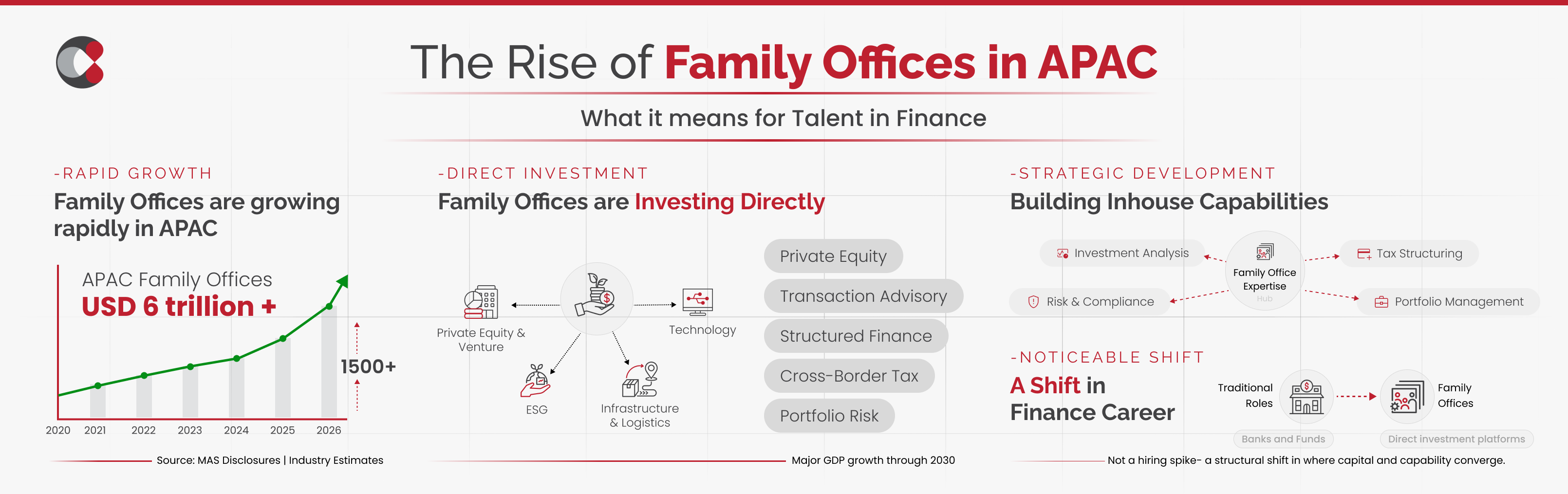
Singapore alone has seen the number of single-family offices grow from fewer than 400 in 2020 to well over 1,500 by 2024, according to MAS disclosures. Hong Kong has also introduced tax concessions to attract family capital, positioning itself strongly for North Asia-linked wealth.
This expansion is not just about wealth migration. It reflects a broader shift in how capital is structured and deployed across the region.
.png)
Capital Is Becoming More Direct
Family offices across APAC are increasingly investing directly rather than relying solely on external fund managers. (Read More) Globally, family office assets are estimated to exceed USD 6 trillion, with APAC representing one of the fastest-growing segments.
Investment themes commonly include:
Private equity and venture opportunities across Southeast Asia and India.
Real assets such as logistics, infrastructure, and energy platforms.
Technology and digital transformation businesses.
ESG-aligned and sustainability-focused investments.
Direct deployment requires deeper in-house capability.
As a result, many family offices are building internal teams covering investment analysis, portfolio management, risk oversight, tax structuring, and treasury functions.
The Hiring Shift: Selective but Strategic
Unlike banks or asset managers, family offices do not hire in volume. However, the calibre of talent sought is high.
Candidates with backgrounds in private equity, transaction advisory, structured finance, cross-border tax, and portfolio risk management are increasingly relevant.
The appeal lies in breadth of mandate. Professionals often handle investment evaluation, ongoing portfolio oversight, and strategic advisory within the same role.
This is less about hierarchy and more about judgment.
Why Singapore Is Central
APAC’s economic growth trajectory, combined with regulatory stability in Singapore and tax incentives in Hong Kong, makes the region a natural hub for capital management.
With Southeast Asia and India expected to contribute a growing share of global GDP growth through 2030, family capital is positioning itself closer to opportunity.
Takeaway:
The rise of family offices in APAC represents a structural shift in where finance talent is deployed. While hiring volumes are modest, demand for experienced, commercially mature professionals with cross-border exposure is increasing.
This is not a cyclical hiring spike. It is a reallocation of capital and capability.